Why plant native species?
- They provide habitat and resources for wildlife.
- They’re better at attracting local wildlife such as birds, butterflies, bees, etc. since they co-evolved together!
- They’re adapted to our climate, and therefore also easier to care for , leaving you with more time to enjoy your garden!
- Resource conservation– Since they’re adapted to live here, they require fewer inputs (resources) such as fertilizer or water1. They actually can use up to half as much water as non-native plants2
Let’s begin with the most daunting task… identifying plant species that are native to your geographical region. Don’t worry, we will not be choosing which species to plant just yet. Instead, we will compile a comprehensive list of native plants, that will slowly be narrowed down to what works in your space over the next few posts.
Luckily for us, Montreal’s Espace Pour La Vie has already done the hardest part for us, and not only has a list of native plants for our region, but ones that can be planted in gardens specifically to support biodiversity- phew!

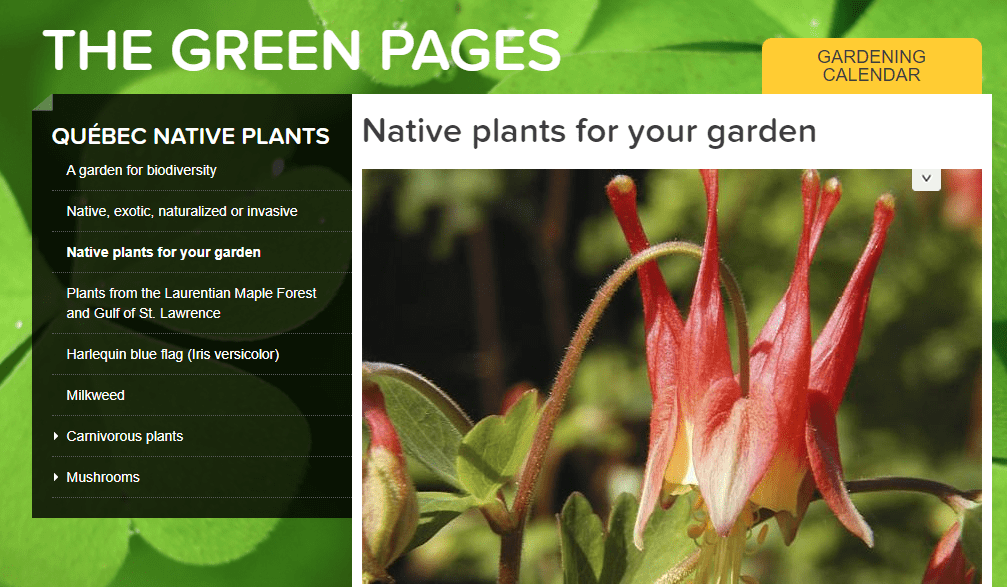
If you’re not in Montreal, don’t worry, the National Wildlife Federation also has a list of plants native to North America, sorted by ecoregions. By looking at the color-coded map, simply find your region, check the legend to see what ecoregion you’re in, click- and voilà, a list of native keystone species!


As we can see, Quebec is mainly split between Taiga for northern Quebec, and Northern Forests for southern Quebec. However, if you notice that strip of green that cuts through the Northern Forests, connecting Montreal, Ottawa, and Toronto from the Saint Lawrence to The Great Lakes… That is known as the Saint Lawrence Lowlands, and it is in the Eastern Temperate Forests ecoregion3. Since Montreal is in this ecoregion, I will be focusing on species from this list, and the one from Espace Pour la Vie.
I know, that list is quite long, but don’t feel overwhelmed just yet…
Right away there are already many categories of plants that can be removed from the lists that are not suited to most balcony gardens, such as large shrubs, trees, and large perennials. Why? Simply because trees and many shrubs are too big, and many containers don’t provide enough insulation for perennials to survive the winter, so we will need to limit the number of perennials according to how much space we have4.
However, since I do have an unusually large balcony compared to most apartments in Montreal, I might make a few exceptions if a plant is especially good at attracting specific species (such as milkweed for monarchs).
While I have your attention, I would love to mention a few fun facts about this incredible region we inhabit known as the Saint Lawrence Lowlands…
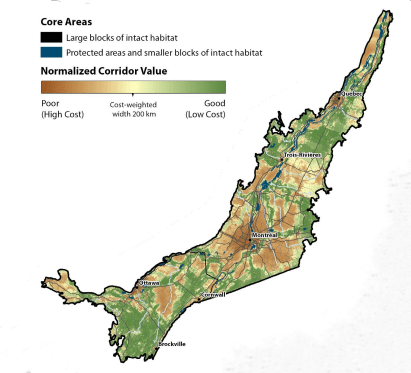
With this in mind, let’s try to make this area more corridor-friendly for wildlife that depend on this richly biodiverse region. Love it, respect it, take care of it… and let’s get exploring!
- https://www.ecolandscaping.org/native-plants/ ↩︎
- https://www.nationalgeographic.com/environment/article/native-plants-garden-lawn-pollinators ↩︎
- https://www.natureconservancy.ca/assets/documents/nat/casc/St-Law-Low_ERS.pdf ↩︎
- https://extension.unh.edu/blog/2018/11/how-can-i-overwinter-perennials-still-containers#:~:text=Even%20if%20they%20are%20hardy,systems%20of%20plants%20in%20containers. ↩︎
- https://www.pollinator.org/pollinator.org/assets/generalFiles/StLawrence-2017.pdf ↩︎
- https://www.natureconservancy.ca/assets/documents/nat/casc/St-Law-Low_ERS.pdf ↩︎
- https://www.natureconservancy.ca/assets/documents/nat/casc/St-Law-Low_ERS.pdf ↩︎
- https://www.natureconservancy.ca/assets/documents/nat/casc/St-Law-Low_ERS.pdf ↩︎
 Amanda Gregoire
Leave a comment